
"From Samosas to S'mores" by Shreya Hosur (Hancock County)
For as long as I can remember, I have lived as two people. One wears sneakers and speaks quickly in English, laughing too loudly in hallways and blending into classrooms. During lunch, she quietly throws away the idli and chutney her mom packed and trades for a slice of pizza or peanut butter sandwich so she doesn’t have to explain the smell. On picture day, she begs her mom not to braid her hair the way she usually does. She hides the henna still faint on her hands after a cousin’s wedding, tucking them into her sleeves. She rolls her eyes when her dad calls her by her Telugu (a South Indian language) nickname in public, although a small part of her loves the sound. A classmate asks if she speaks “Indian,” and she corrects them softly — but they’ve already moved on. In history class, when the lesson briefly touches on India, everyone turns to look at her — and she shrinks into her seat, cheeks burning. Friends quote lines from a show she isn’t allowed to watch, and she nods along, hoping they don’t notice. She begs her parents to buy her the clothes the other girls wear, but they never do.
The other slips off her shoes at the door and folds her hands before an altar. But here, too, I am out of place. I stumble over the words my grandparents say, their Telugu laced with a rhythm I can’t quite follow, nodding and smiling even when I don’t fully understand. My aunts laugh gently when I try to pronounce a dish or a blessing, mimicking the roundness of my American accent. At family gatherings, they cluck their tongues at the shorts I wear, tugging at the hem and telling me “good girls” don’t dress like that. They tease me for not knowing how to drape a saree properly, for holding my spoon instead of my hands at the dinner table, for forgetting the right response to an elder’s blessing. Someone hands me a spicy snack, and my eyes water, but I force a smile and say it’s “delicious.” I wear bright, casual clothes to a family gathering, and my aunt whispers about how “modest” I should be. I fumble with serving utensils or dishes at a buffet-style meal, spilling a little rice, and everyone pauses to watch. I get asked about arranged marriage casually by relatives, and I laugh awkwardly without knowing what to say.
Both are me. And yet, at school I am too Indian. At home, too American. I hover between two worlds, belonging fully to neither.
That in-between followed me to the BAPS Swaminarayan Akshardham temple in New Jersey, where my parents, grandparents, and cousins spent a Saturday in 2025. I always claimed to hate temple visits — a small rebellion against tradition — but the truth was quieter. It wasn’t the temples I disliked. It was how they reminded me of how little I knew, how far I was from the certainty my family carried with them like second skin.
The temple rose before us like a dream carved into stone — white marble unfolding beneath a pale sky, its spires etched with stories too old for language. Every inch was alive with detail: curling vines, gods frozen mid-myth, lotus petals repeating like a heartbeat. Even before we stepped inside, the place felt sacred and alive. A bronze statue sat in meditation near the entrance, beads slipping through its hands, its surface weathered to a soft green glow where sunlight touched it. Pools of water spread out like sheets of glass, reflecting temple and sky so perfectly that the two worlds seemed to merge. Pink lotus blossoms floated gently across the surface, cradling drops of water that glistened like pearls. The air carried the scent of sandalwood and rain-washed stone, and the faint toll of a distant bell seemed to steady the space, as if the building itself were breathing.
At the edges of the courtyard, the grass was soft and cool beneath my shoes, dotted with marigolds and chrysanthemums bursting in saffron and violet. Hidden lanterns tucked between them cast halos of pink and orange that shimmered against the water’s edge. A breeze rippled the pool, scattering sunlight across the marble and setting the reflections swaying. People drifted across the grounds in quiet devotion — some barefoot, some murmuring prayers — their reflections bending and reforming with every movement. Even the smallest details — the brush of sandals on stone, a leaf drifting across the water, the low hum of a mantra — felt intentional, part of a rhythm much older and larger than me.
My mom handed me a T-shirt to cover my shoulders, a small reminder of rules I never seemed to remember until I broke them. Even before stepping inside, the place felt alive. A towering statue of Buddha stood balanced in tree pose, his gaze soft and infinite, as if he saw past centuries and straight through me. Pools of water spread like mirrors beneath him, dotted with pink lotus blossoms that trembled in the breeze. The air smelled faintly of sandalwood and incense, a scent that clung to the back of my throat — warm and ancient, like something sacred I had forgotten.
I posed in front of the statue, lifting one leg and joining my hands above my head, mimicking the yoga poses I’d learned at school. My dad lifted his phone and told me to smile, and for once, I didn’t flinch at the sound of Telugu around me. Here, it wasn’t foreign or embarrassing. Here, everyone was speaking a language like ours. English was a stranger for once.
We lined up for family photos by the fountains, and I stepped onto a low stone ledge to look taller. A woman shouted something in Hindi (a North Indian language) from behind my mom, and my family laughed. “She says to get down,” my cousin translated. I felt the heat rush to my cheeks as I climbed down. I hated how often I needed things translated. How often I felt like a visitor in my own culture.
Inside, the temple swallowed us whole. Light slid across the marble floors like water, scattering into soft pools beneath our feet. The ceilings arched high above, carved into swirling patterns of gods and galaxies, every inch alive with devotion. Statues rose at every turn, each with a story written in the curve of a hand or the tilt of a crown, and their painted eyes seemed to follow us, patient and knowing. The air was cooler here, and each breath felt deliberate, as if the building itself was teaching me how to breathe more slowly. I followed my father from one to the next, pressing my palms together and bowing slightly, whispering names I didn’t know.
“The god of the sun,” he murmured at one altar, and I nodded, as if the words themselves were a bridge between us. Oh. Like Apollo. I thought.
At the final shrine, we offered spoonfuls of water to Lord Shiva (equivalent of Dionysus), bathing the god’s head as tradition commanded. “Watch me,” my father said, and I studied his motions closely. When I reached out with my left hand, his eyes widened in warning and I switched to my other hand, cheeks burning again. He dipped his finger into kumkum (red powder) and pasupu (yellow powder) and marked a dot between his brows, then touched one gently to my forehead. I watched the younger children around me do it themselves and felt a small ache in my chest.
A priest approached with a tray holding a small flame, marigold flowers, and coins left by others before us. My parents cupped their hands above the fire and touched them to their eyes three times. I followed, holding my hands just close enough to feel the heat sting my skin. The flame wavered, and for a moment I wondered if it knew I was pretending.
We stepped out into the foyer again, and I caught myself wishing I could take pictures, capture the glow of marble and the quiet gravity of the statues. But my father shook his head gently. “Photographs steal the gods’ power,” he said. “Each one takes a little piece away.”
Outside, the air felt cooler. We posed by the gold-lined paths and elephant statues before my dad returned with prasadam — temple sweets soaked in syrup. They have always been my favorite part.
Back in the car, I let the sugary liquid slide down my throat and melt on my tongue. The temple grew smaller behind us, a white silhouette fading into the horizon. I still didn’t know all the prayers. I still stumbled through the rituals. But somewhere between sandalwood and syrup, between Telugu and English, the two versions of me stopped fighting. For a moment, they stood together — not too Indian, not too American, just whole.
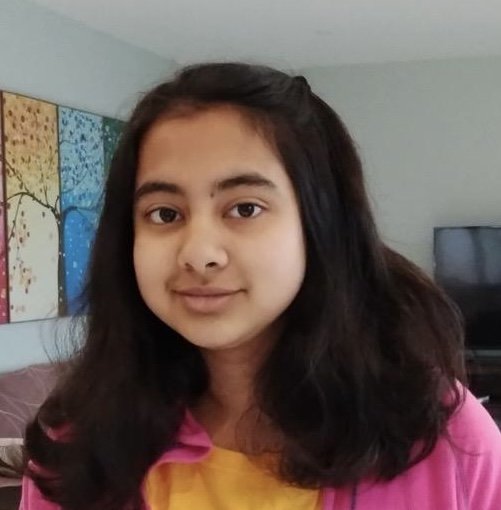
SHREYA HOSUR lives in Bar Harbor, Maine, and is a freshman who loves writing. Her piece, “From Samosas to S’mores,” is autobiographical and explores her personal experiences, but she also enjoys writing fiction. At thirteen, Shreya published her novel Suspect #1, a murder mystery; mystery is her favorite genre to read and write.