The Founders Prize is awarded annually by the three founders of The Telling Room: Susan Conley, Sara Corbett, and Michael Paterniti, to the author of the best piece of writing to emerge from a Telling Room program.
Congratulations to our 2026 Founders Prize recipient, “My Ndombolo: The Hum of the World” by Norka Kalonji!
A Few Words from the Founders
“This is a powerful piece by someone with off-the-charts talent. Literally breathtaking. We were each individually left speechless by it.”
My Ndombolo: The Hum of the World
by Norka Kalonji
“Okufi na makolo?” my uncle shouted over the music. “Did your legs die?”
Heat climbed up my neck. I laughed with everyone else, but my stomach dropped.
Seconds earlier, I stepped onto the dance floor at his anniversary party, trying to keep up with Koffi Olomide’s “Papa Ngwasuma.” I bent my knees and rolled my hips like my cousins, smooth and circular, but my body kept arriving late to the beat. My uncle grinned. “Ozangi mouvement.” “You lack movement.”
At Congolese gatherings, nobody hands you instructions. A song comes on and the room expects an answer. My cousins answered easily. They began to dance Ndombolo, shoulders loose, feet sharp, faces bright. Aunties clapped on the off-beat. Someone whistled from the kitchen. I hovered at the edge, stepping in and out, counting the rhythm and watching where they put their weight. I wanted to belong without becoming the joke again.
When I could not locate the beat with my feet, I learned to bring it home. I wrote what I could not perform. I filled a notebook the way my family filled the dance floors, returning again and again until something shifted. Words became my rehearsal space. I tested rhythm in margins, counted breath in line breaks. Learned where weight belonged in a sentence. I had loved language quietly for years, the way you hum only when you believe no one is listening. That secrecy broke when I entered the Breccia poetry contest at my high school. The night before the deadline, my science Olympiad notes laid beside me, phrases circled like evidence: carbon rich, irregular rotation, silent drift. By morning, they had rearranged themselves into a poem about gravity. When my name was announced as the winner, the prize was a five-dollar gift card. I carried it home not for its value, but because it proved that my words had crossed distance—that something written in stillness could move someone else.
That experience shifted my relationship with attention. I no longer waited for large moments to justify writing. I began trusting the significance of subtle experience. I watched the light shift across rooms. I listened to the tension in voices. I valued the ordinary as worthy subject matter. My focus settled into careful observation.
The world hums in quiet details that most people overlook: the tilt of a sunbeam across a table, the way my cat pauses mid-step to stare at a shadow, the subtle tremor in someone’s voice when they’re afraid to speak. I don’t need music to feel the rhythm. I trace it with my eyes, with my pen.
After writing, I feel like I’ve stretched my hands toward something just out of reach and finally touched a thought, a feeling, a moment captured in ink. My chest swells and empties all at once, like I’ve exhaled what I didn’t know I was holding.
I write because the world is a puzzle of little things, and I want to understand them, to hold them, to let them dance on a page where they can be quiet but loud all at once. Every story, every sentence, is a heartbeat I can feel, a rhythm I can catch. But heartbeats do not echo in isolation; they carry the memory of the ground they rise from. Mine carries a country inside it.
One thing people don’t know about the Congo is that the land, rich with resources, carries cost. Trauma is not rare or sudden; its routine is woven into daily life so tightly that people learn to move through it quietly. What people don’t know is that the land is unimaginably rich, and that this richness has been a curse. The Congo bleeds not because it lacks value, but because it has too much of it; minerals pulled from the ground to power phones, cars, and cities far away. The pain is often invisible to those who benefit from it. Children learn early that their country feeds the world, yet the world rarely looks back.
Violence doesn’t always arrive with explosions or headlines; sometimes it shows up as a school that closes without explanation, a road you stop using because someone didn’t come back, or a mine that swallows fathers and gives nothing back but dust on their clothes. I grew up learning which questions not to ask, which silences to respect, and which truths are too dangerous to say out loud.
What people don’t see is identity beyond suffering. Congolese life carried laughter alongside hardship. Music persisted. Humor persisted. Pride persisted. Endurance defined continuation. Breaking occurred repeatedly. Standing continued regardless.
Most of all, people don’t know that we are not defined by suffering. Trauma exists, yes, but so does endurance. There is laughter in places outsiders would only expect grief. There is music, stubborn hope, sharp humor, and pride that survives despite everything. The tragedy is not that Congo is broken; it is that it has been repeatedly broken into, and still expected to stand without help or recognition.
My identity has been formed through both reflection and observation. Cultural identity gave context, while my daily interactions gave examples. I watched discipline modeled without discussion and absorbed expectations without instruction.
I remember nights at the kitchen table with my notebook. He was there, and he did not ask what I was writing. He became a provider before he became an adult. In Congo, he sold magazines in the market and took photos of people just to pay for school. The money rarely stayed in his pocket. His father demanded it for alcohol. His mother pleaded for it to cover what was missing at home. At fifteen, he learned a rule that never left him: if you want something, you hold it with your own hands. That is why he valued STEM—not because it is “beautiful,” but because it provided. He tells me education is the one thing no one can take once you earn it, and for once we were aligned.
In our house, emotions rarely get full conversation, but expectations do. He left early, came home tired, and sat down with the same discipline, page after page. I often heard his voice echoing in my mind: “Your generation is soft; do not wait to be rescued.” I heard that as hardness, but writing taught me to understand the fear underneath. He was scared of slipping back into his fifteen-year-old self—needing help and not getting it. That is where my poems begin.
I sit down and jot down the intimate details, still unsure about the final. I thought my choices had to look like that old man’s to count. Science or struggle, numbers or nothing. But writing gave me another route into the same kind of discipline he embodied. As I write, the distance between movement and stillness begins to close. I think of my cousins and uncle—how rhythm lives openly in their bodies, crossing the room without hesitation. I hold my pen like my cousins hold their waist.
My Ndombolo moves differently. It lingers in the pause before a sentence, the smooth and circular curves of a thought as it finds its place on the page. Somewhere between the first and the last word, it becomes clear that motion does not require a floor or audience. The pages hold it for me. In those moments, my legs do not die.

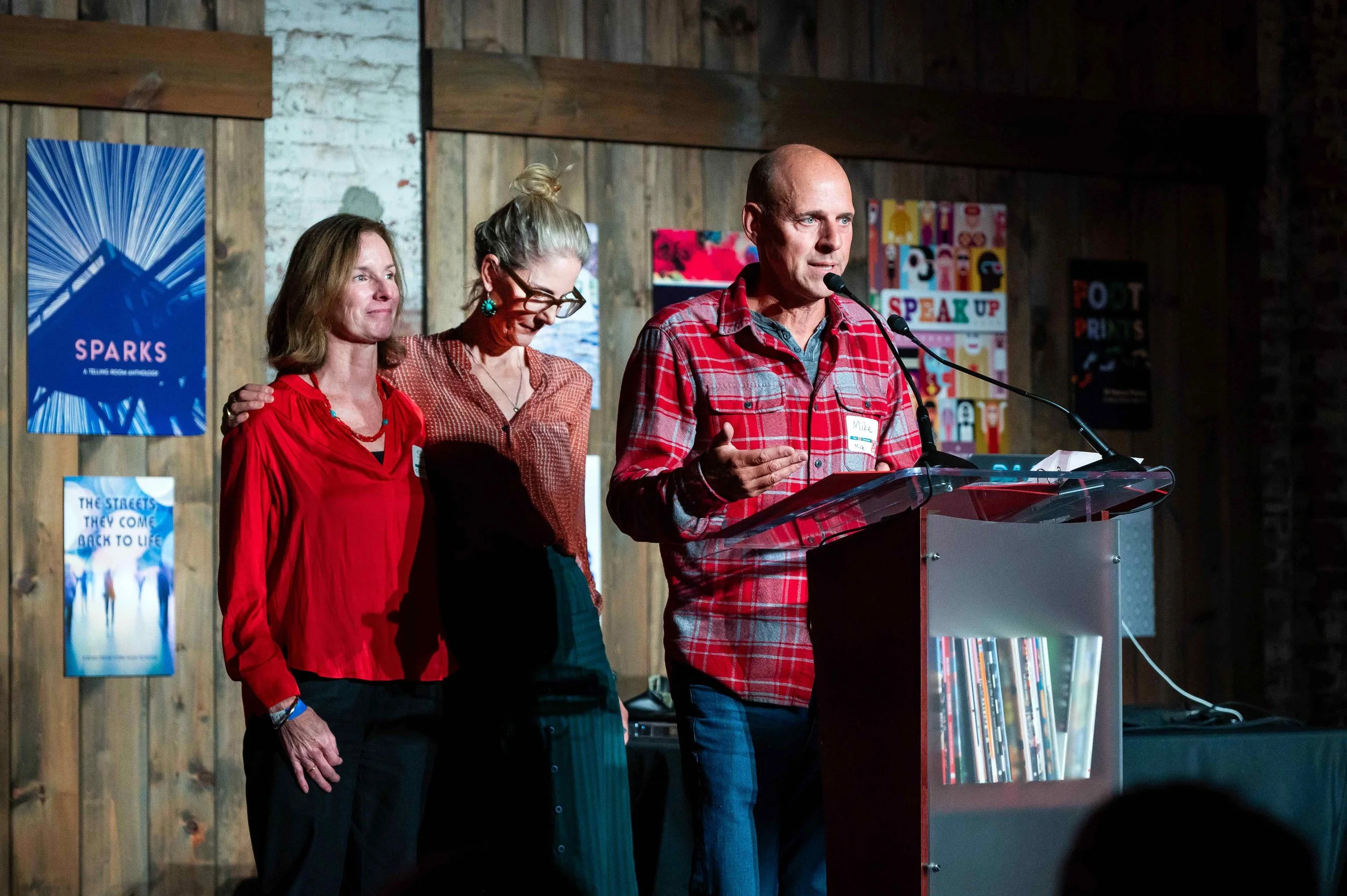
Norka Kalonji (center) is celebrated by Founders Michael Paterniti (left) and Sara Corbett (right) at the Young Writers & Leaders chapbook launch. (Photo by Rylan Hynes)
Norka Kalonji is a senior at Deering High School, passionate about the interaction of STEM and storytelling. Alongside STEM, his work explores identity, discipline, inheritance, and how culture, family, and responsibility shape ambition. He is especially interested in the tension between movement and stillness. Whether solving equations or drafting a page, he works with intention, believing that meaningful progress is built through consistency and self-direction.